This is an old revision of the document!
MAKE FOR EDU - Requirements and evaluation criterias
This document is providing information regarding the evaluation criteria used by the MAKE committee to select MAKE for EDU projects. It also provides information on the financial support projects are elligible to request based on different criteria.
Evaluation criterias
Project related criteria’s
- (mandatory) An EPFL Professor taking in charge the project (see roles and responsability for more information)
- A coordinator (EPFL employee ideally under the responsility of the Professor in charge) to coordinate the project and follow up regaularly with students and stakeholders around the project.
- The project feasibility: long term objectives are challenging but realistic and in line with EPFL pedagogical objectives and scientific disciplines. MAKE for EDU projects are aiming to last at least 3 years.
- The prototype to build is challenging and requiring multiple backgrounds but it is still realistic with the existing EPFL resources and infrastructures
- The budget (including sponsors) is realistic for the objectives set
- Risks (financial, safety/accident, EPFL image/reputational, etc.) shall be identified and mitigated properly, in particular if activities outside of the EPFL campus are planned
Pedagogical criteria’s
- Learning by doing: the project should reinforce theoretical learning seen in courses through practical implementation.
- Open ended: the project should offer the possibility for students to develop their creativity and to look for many different potential solutions
- Interdisciplinarity: favoring interdisciplinarity by allowing students from different backgrounds to contribute to the project. The prototype(s) to be produced must be complex enough to push students to make compromises between disciplines.
- Transversal skills: the project must allow transversal skills development (group/human management, project management, knowledge management etc..).
- Sustainability: MAKE for EDU projects are not expecting to tackle a specific sustainable issue but they are required to raise awareness about sustainability in the technological field related to the project. For instance, participants of the EPFL Racing team project must be aware of the impact of the car industry.
As there are multiple criteria, it is important to clarify that a project will be evaluated in its globality. A project can be very strong regarding a given criteria and less developed in another.
The strategic and operational committees will evaluate the global picture of every project in their selection process.
How much funding can we request for our project ?
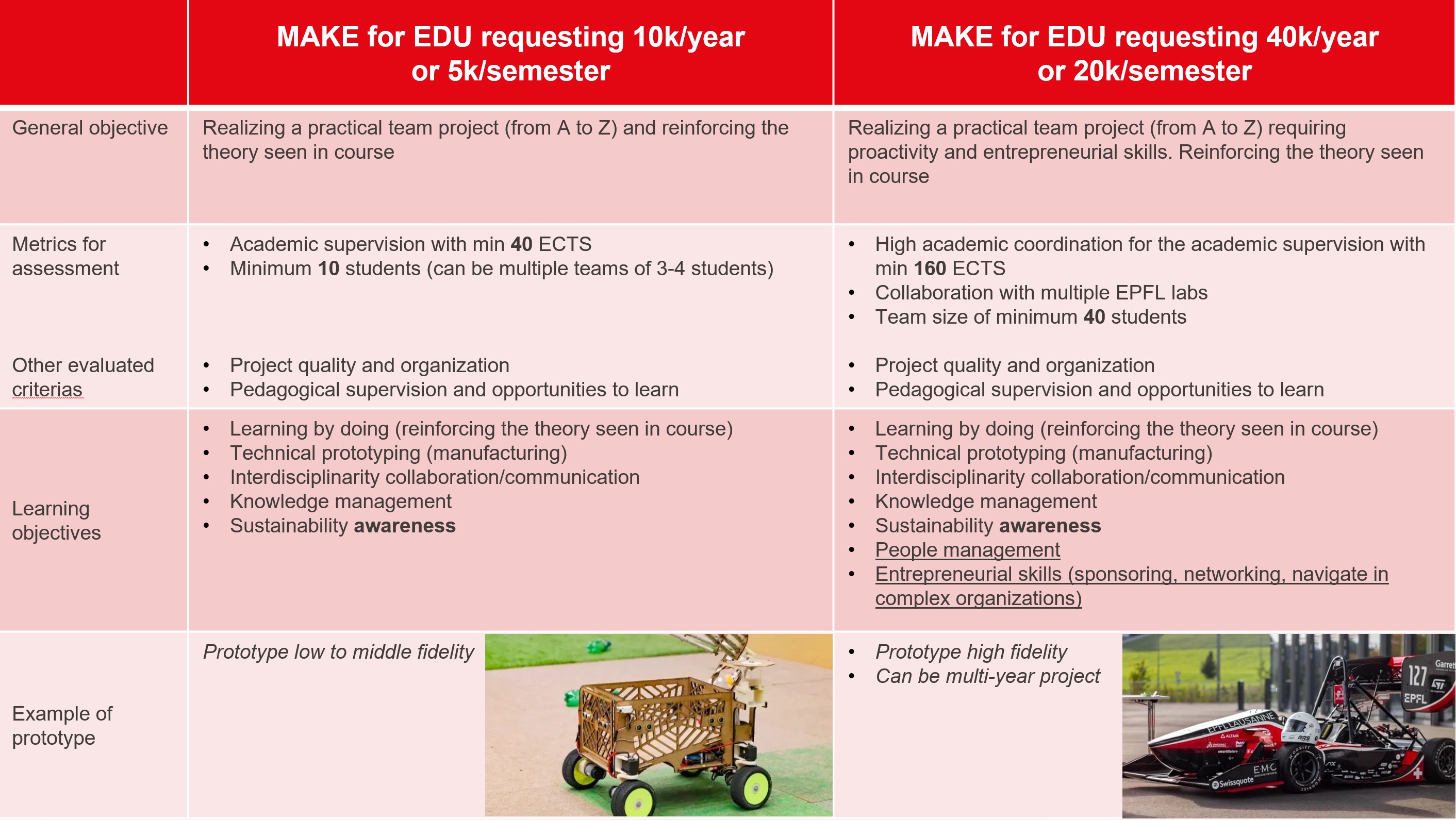
One of the important objective of MAKE for EDU projects is to put in practice the theory seen in courses, the MAKE committee decided to provide a few metrics to guide projects regarding the financial support they are elligible to request.
In the futur, the expectations from the MAKE committee in terms of ECTS credits and number of students is likely to increase for MAKE for EDU projects.
The figure here under is providing two examples of MAKE for EDU projects and their respective funding requests. A maximum of 1000chf.- /student participants and a minimum number of ECTS credits is requested by the committee.
The number of ECTS credits and the number of student participants will not be eliminatory criteria for the academic year 2026-2027. However, for 2027-2028 they will become mandatory requirements, it is therefore important to prepare an academic network (support from different professors/lab) to be able to reach these expectations in the futur.
MAKE for EDU of MAKE for SOCIETY ?
